
What’s New at the Reserve? Spring 2026
Welcome Dr. Molly Wick!
It is with great excitement that we announce the arrival of Dr. Molly Wick to the Lake Superior Reserve staff as the new Research Coordinator. Here is a brief introduction from Molly:

Dr. Molly Wick
Research Coordinator
Lake Superior National Estuarine Research Reserve
I am a transdisciplinary social-ecological scientist with training and experience in collaborative, community-engaged mixed qualitative and quantitative environmental research. I have a PhD and a M.S. in Water Resources Science from University of Minnesota, and a M.S. in Earth and Planetary Science from University of New Mexico. I hold expertise in cultural ecosystem services, human-nature relationships, aquatic ecosystem assessment, coastal and estuarine habitat restoration, and environmental decision-making. My research strives to be value-driven, place-based, and highly collaborative with tribal, government, and NGO entities.
My PhD research, with support of a Margaret A. Davidson fellowship, was a collaborative study that investigated how identity influences relationships with and barriers to water access at the Lake Superior Reserve. I completed two research fellowships with USEPA through Oak Ridge Institute for Science and Education, focused on Great Lakes ecosystem assessment and cultural ecosystem services mapping. Most recently, I was the Lake Superior Program Coordinator with the Wisconsin Department of Natural Resources. I also have expertise in science communication. I was selected as a Scientists Promoting Policy, Access, Research, and Knowledge (SP2ARK) Fellow by the Consortium for Aquatic Science Societies in 2024. I have lived in, worked in, and studied the Twin Ports and Chigami Ziibi (St. Louis River Estuary) region since 2011. I am beyond excited to continue to explore and study this beautiful and significant place as the Reserve Research Coordinator.
Please extend a warm welcome to Molly whenever you see her!
NEW Estuarium exhibit highlights importance of Ishkode (fire)
When was the last time you stopped into the Lake Superior Estuarium? If you visit the Estuarium this summer, you can experience a brand new exhibit!
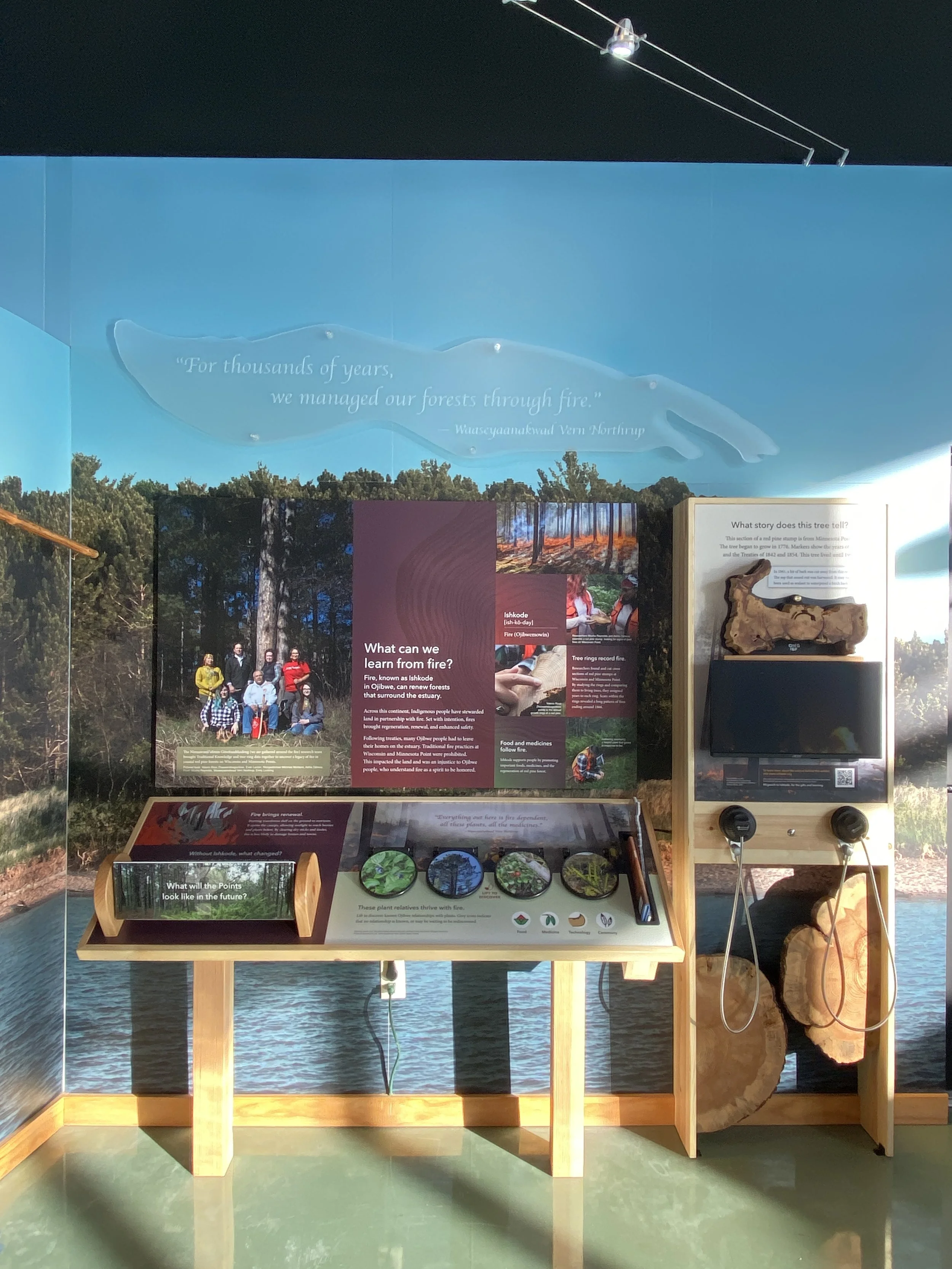
Photo: the new Ishkode exhibit installed in the Lake Superior Estuarium (credit: Deanna Erickson)
Installed in late February of 2026, this exhibit is all about Ishkode (fire in Ojibwe) and how its relationship with Ojibwe people has had a profound effect on Great Lakes pine forests. The exhibit highlights fire’s benefits to the landscape, other beings like plants, as well as the land’s caretakers.
The exhibit incorporates knowledge from the Wisconsin Sea Grant funded study, Nimaawanji’idimin Giiwitaashkodeng (we are gathering around the fire), which incorporated Ojibwe oral histories and stories with analysis of red pine samples using dendrochronology. The study came to the conclusion, which Ojibwe people of this area have always known, that the ecosystems around us are shaped by Indigenous relationships with fire and that it is an essential part of these fire-dependent areas, especially in the pine forests.
There is additional input from the plant guide Ganawenindiwag: Working with plant relatives to heal and protect Gitchigami shorelines, which references plant beings that thrive when exposed to fire. The exhibit also incorporates the trailer to the short film, A Wilderness Act, which was produced by Old Saw Media and features the researchers from Nimaawanji’idimin Giiwitaashkodeng.
On March 27, community members gathered along with staff from the Lake Superior Reserve and the teams working to bring Ishkode back to Wisconsin and Minnesota Points. Staff hosted an open house to view the new exhibit, followed by an opening ceremony and a panel with members from both the Wisconsin and Minnesota teams. Panelists discussed why Ishkode is a vital part of the ecosystems of the Points and how each team is bringing it back to these places.
Featured panelists included Dr. Evan Larson (professor at UW-Platteville and co-lead researcher on Nimaawanji’idimin Giiwitaashkodeng), AmberBeth VanNingen (MN Department of Natural Resources), Pat Sterner (Board Chair of MP50), and Callie Grones (AmeriCorps Member with the Lake Superior Reserve). Moderators were Bazile Minogiizhigaabo Panek (CEO and founder of Good Sky Guidance) and Nisogaabokwe Melonee Montano (co-lead researcher on Nimaawanji’idimin Giiwitaashkodeng and graduate student at the University of Minnesota-Twin Cities).
Stop by the Estuarium this summer to see this brand new exhibit! The summer hours begin on June 9th and are as follows: Tuesdays-Saturdays from 10am-5pm
Lake Superior Reserve buoy deployed for the season
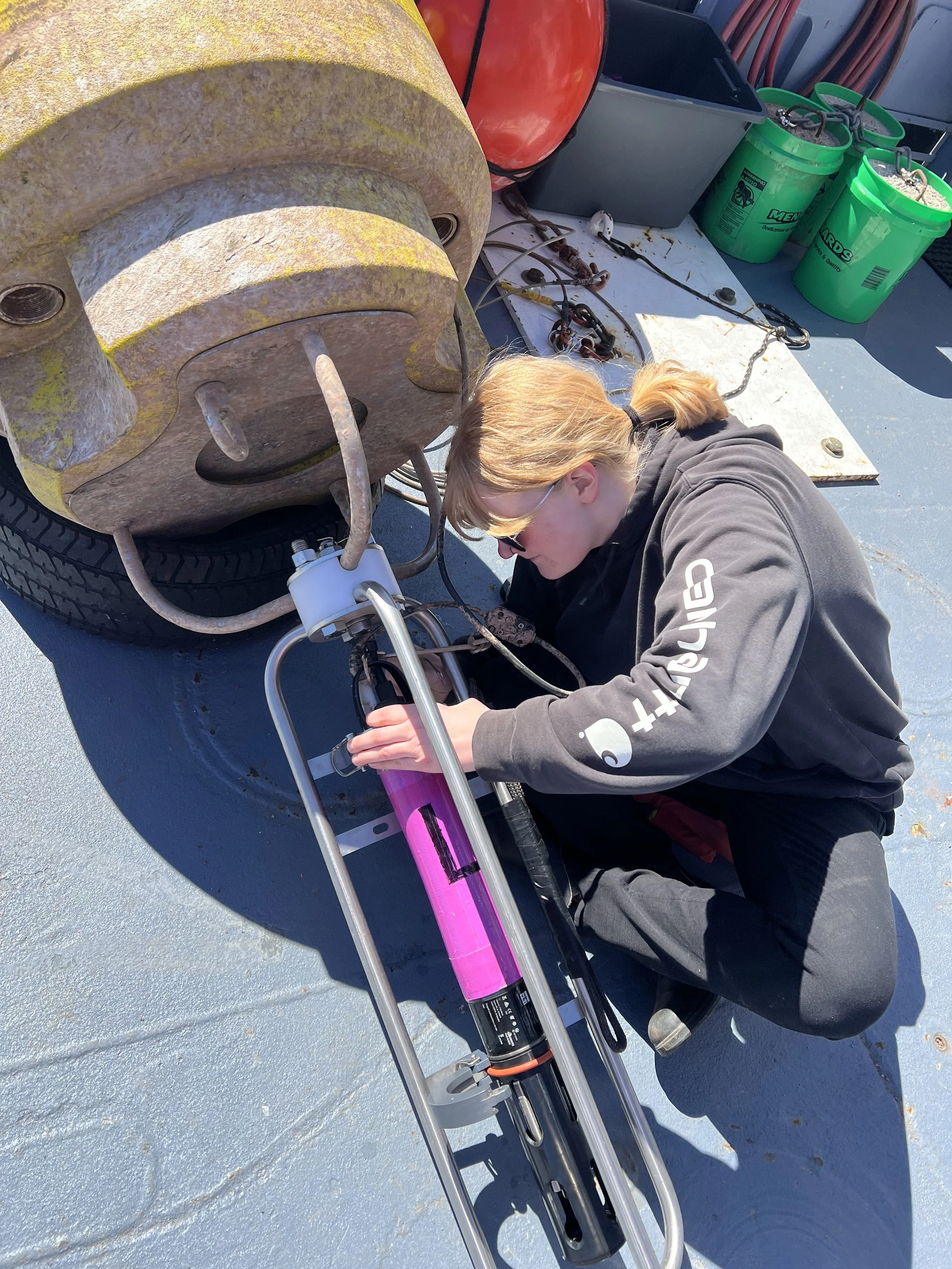
Photo: Reserve researcher, Addi Knoll, attaching a sonde to the monitoring buoy before its deployment into Lake Superior
(credit: Addi Knoll)
Spring means it’s time for water quality monitoring at the Lake Superior Reserve. Among several pieces of equipment deployed by the Reserve each year, is a water quality buoy. Reserve Researchers Addi Knoll and Cecile Renfro helped cast it off into Lake Superior in mid-April with the help of the University of Minnesota-Duluth Blue Heron research vessel.
The buoy was constructed at the Lake Superior Reserve by a UMD student with funding from the Great Lakes Observing System in 2024. This buoy tracks water quality parameters in Lake Superior, where, in the past decade, harmful algae blooms (HABs) have become more prominent. HABs occur when cyanobacteria (or blue-green algae) multiply rapidly, often creating noticeable bright green scums on the water’s surface. These blooms can produce toxins harmful to wildlife, pets, and people. The buoy is designed to help the Reserve learn more about when and why blooms occur.
The buoy is anchored approximately ⅓ mile off Wisconsin Point where it will remain until November. Every 15 minutes the buoy collects data then transmits it to the Great Lakes Observing System’s Seagull data platform for all to see.
You can check out real footage of the buoy deployment from a story on FOX 21: UMD Blue Heron begins Lake Superior buoy research season (aired April 22, 2026).
The Lake Superior Reserve is growing
Renovations coming soon!
The Lake Superior Reserve includes two buildings on Barker’s Island in Superior, WI. The red building is the outreach and education center, the Lake Superior Estuarium, while the blue building contains staff offices and the laboratory.
This summer, the blue building will be receiving a much needed expansion. Currently, the blue building has seven offices for 11 full-time employees plus two staff from Wisconsin Sea Grant. This expansion includes an additional eight offices, conference room, and 24 solar panels located on the roof of the building.
These additions will greatly benefit the staff and allow for room to grow in the future. The construction is expected to begin in June and finish in November will be confined to the space between the blue and red buildings of Barker’s Island.
Article by Callie Grones, edits provided by Hannah Nicklay, Kirsten Rhude, and Molly Wick
Cover photo: Lake Superior Reserve buoy suspended in the air on UMD's Blue Heron research vessel to be lowered into Lake Superior (credit: Addi Knoll)