
What’s New at the Reserve - Summer 2026
The Lake Superior Reserve strives to provide students and young professionals with the chance to expand their knowledge and skillsets in subjects they are passionate about. This summer, five students joined the staff at the Lake Superior Reserve to pursue research, stewardship, and education projects that benefit both their educational and career pursuits as well as the Reserve's mission. This edition of "What's New at the Reserve" features two students who spent their summer working at the Lake Superior Reserve.
Meet Olive!
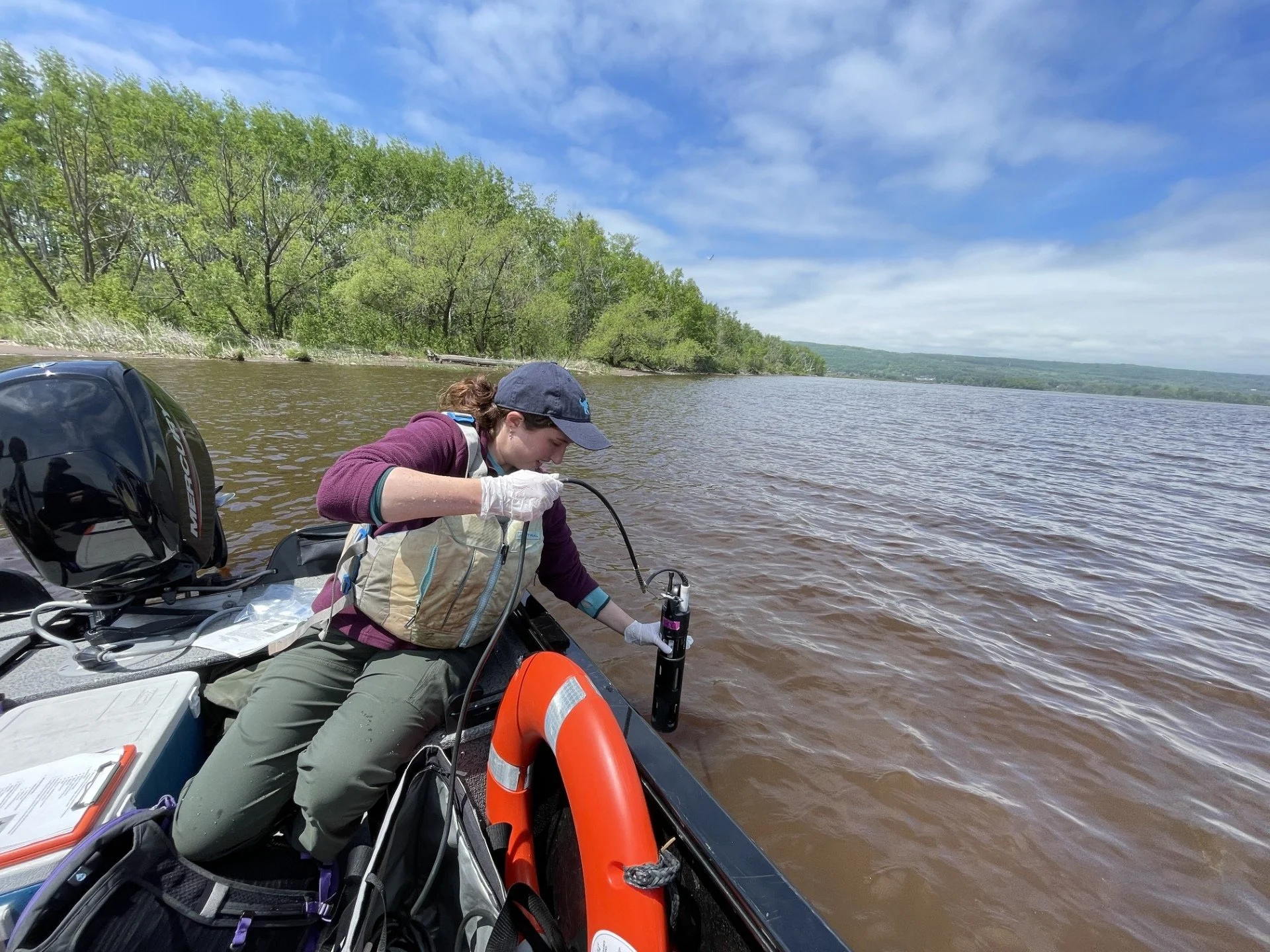
photo: Olive takes a water quality sample with a sonde. (credit: Olive Stern)
Olive is starting her PhD program in Biology at Rensselaer Polytechnic Institute (RPI) in New York this upcoming fall. Before her semester starts, Olive has spent her summer working at the Lake Superior Reserve with research and monitoring staff. Her connection to the Lake Superior Reserve began when she accepted a position in a lab at RPI with her advisor Dr. Kait Reinl, the former Research Coordinator with the Reserve. Olive’s interests include phytoplankton ecology, cyanobacteria, and harmful algal blooms. Coming to the Lake Superior Reserve has provided Olive with the opportunity to study her interests in a new freshwater system.
“Algae is the foundation of everything. This is why it’s so important.”
Since arriving at the Reserve, Olive has been busy taking samples in the St. Louis River Estuary for several different projects. Part of her work contributes to a project led by the United States Geological Survey (USGS) that studies how harmful algal blooms are changing spatially around the estuary. Harmful algal blooms (HABs) are occurring more frequently across the estuary and Lake Superior, especially within the last decade. When cyanobacteria (sometimes known as blue-green algae) in our waterways grow out of control, which creates a “bloom”, toxins can be released that are harmful to wildlife, pets, and people. Though cyanobacteria is a naturally occurring organism and is important to ecosystems, too much of them can cause these issues.
Olive’s participation in this USGS project has direct impacts on ecologists' understanding of phytoplankton populations as well as recreational implications for the general public. Through this work, she responds to algal blooms across the estuary and practices her cyanobacteria identification skills.
Olive has also been a part of a project called HABSMART (Harmful Algal Bloom Science, Monitoring, and Response Tools). A collaboration between the Lake Superior Reserve, University of Minnesota-Duluth Natural Resources Research Institute, University of Wisconsin-Madison, and RPI, the goal of HABSMART is to investigate hypotheses of why harmful algal blooms are occurring in the estuary. Project partners will also work with the collected data to develop early warning responses that could predict when HABs may occur.
“I love studying a system that means so much to people.”
Between routine sampling, responding to bloom events, and analysis in the Reserve’s lab, Olive has spent much time this summer around the St. Louis River Estuary directly impacting the work of understanding phytoplankton, cyanobacteria, and harmful algal blooms. She enjoys studying freshwater systems like the St. Louis River Estuary and is thankful to be catching these bloom events because of their impact on the study of cyanobacteria and harmful algal blooms. Olive will return to the Lake Superior Reserve next summer to continue her amazing work.
Meet Christian!
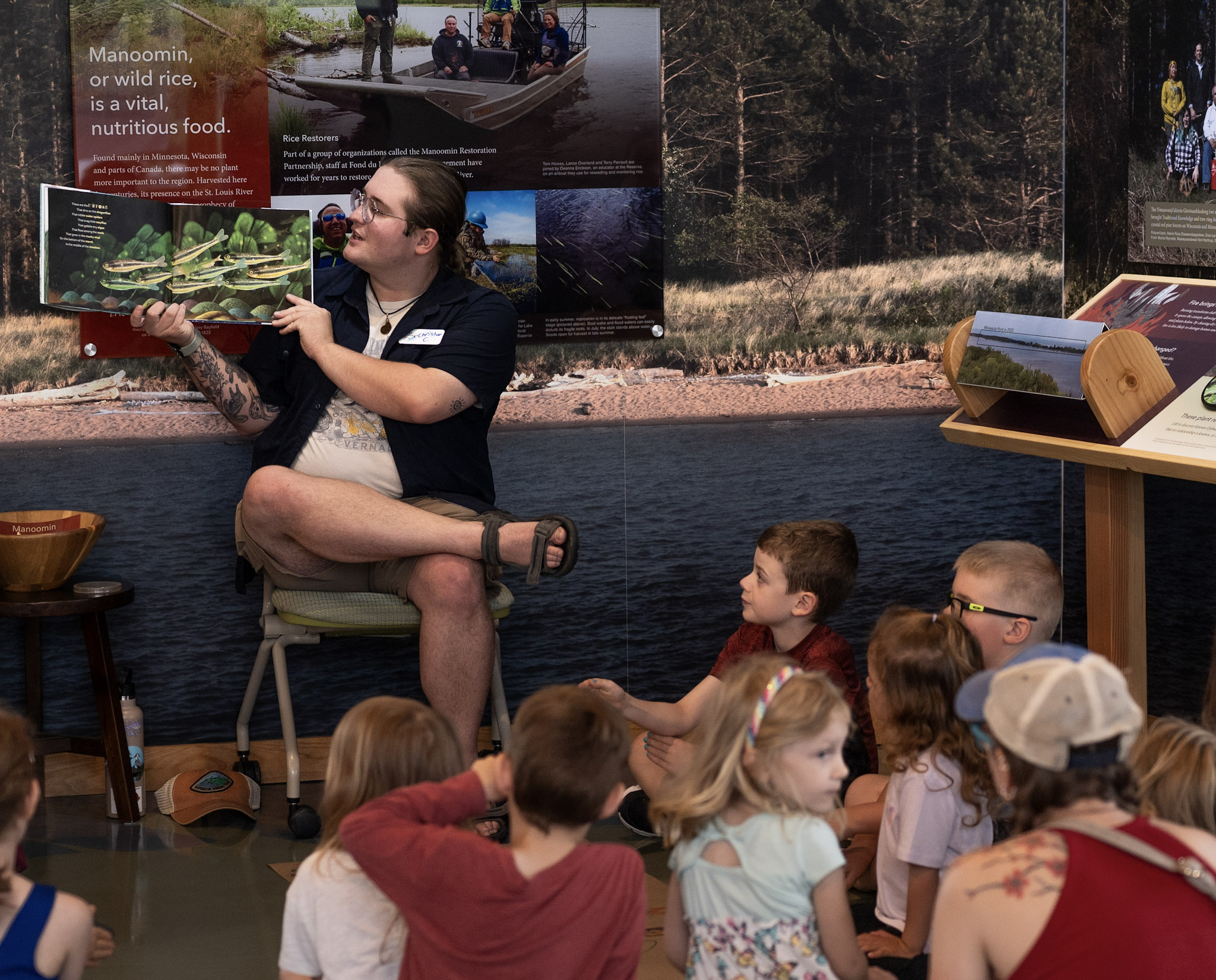
photo: Christian reads a book for the River Rovers program at the Lake Superior Estuarium. (credit: Christian Cutsforth)
Christian is starting his Master’s program in Environmental Education at the University of Minnesota-Duluth this fall. Originally from northeast Iowa, he began working at the Lake Superior Reserve in May 2026 as an Estuary Educator. From day one, Christian jumped right into programming here at the Lake Superior Reserve with the education team, including assisting with a field trip for middle schoolers sampling for macroinvertebrates
Christian is tasked with coordinating the River Rovers summer nature playgroup at the Lake Superior Estuarium. A free community program designed for 3-7 year olds and accompanying adults, River Rovers provides participants with the opportunity to learn about a new nature topic every week. Christian has hosted events focused on wetlands, water cycles, birds, plants, and rocks and geology. River Rovers has allowed Christian to channel his interests into creating different programming for 3-7 year olds. He finds challenge in designing engaging activities for the range of ages and has managed to provide nature education to 71 total participants so far.
Aside from working directly with students, Christian has also been helping teachers bring nature learning into their classrooms. He has assisted the education team with the Rivers2Lake program, which provides mentorship, training, and resources for participating teachers to engage their students in place-based environmental education. In addition, Reserve education staff often visit classrooms and facilitate field trips to spots in the St. Louis River Estuary or at the Great Lakes Aquarium.
“I still can’t believe I get to work directly on the estuary! It yields itself as the perfect sensory-immersive classroom.””
Christian was also a co-host of the Great Lakes as a Classroom workshop, which brought together 21 educators from across the Great Lakes region, specifically from locations where National Estuarine Research Reserves reside on Lake Superior, Michigan, and Erie coastlines. Teachers were able to learn more about the Great Lakes as a whole system, participate in stewardship and field experiences on the St. Louis River, receive resources on how to incorporate Great Lakes learning into their classrooms, and learn about lesson plans and presentations.
Christian is staying with the Reserve until the end of the year with the potential to stay on staff until next May. He’s excited about getting into the classrooms and working with a variety of teachers and grade levels, ranging from pre-K to high school. Though unsure of what he would like to do after his graduate program, he’s hoping to receive his teaching license or become a park naturalist.
From curriculum building to assisting teachers, Christian has helped bring environmental education to students and teachers to the St. Louis River Estuary and across the Great Lakes region.
Article by Callie Grones
Based on information from interviews with Christian Cutsforth and Olive Stern