
An AmeriCorps Service Story
Callie Grones is currently serving her second term as the Friends of the Lake Superior Reserve AmeriCorps member, a position she’s held for the past year and a half. Her service has led her down many roads, from coordinating FOLSR events to communicating with the public through newsletters, emails, and face-to-face outreach, and assisting the Lake Superior Reserve with many projects throughout the year.
Recently, Callie had the opportunity to share her service story with attendees of the St. Louis River Summit. The theme of the Summit was Grit and Gratitude: Celebrating St. Louis River Successes. She highlighted all of the work she’s accomplished with many different individuals and organizations in the region, while also shedding light on some difficult moments of her service, like when she received notice that her AmeriCorps grant had been abruptly terminated in April of 2025. Through the ups and downs, Callie continues her service with the Friends of the Lake Superior Reserve and will wrap up her second term at the end of August 2026.
She is also the recipient of a Governor’s Service Award for AmeriCorps Member of the Year (2026) in the state of Wisconsin and will travel to Madison in June for the awards ceremony.
Here’s her story from the St. Louis River Summit:
A Little Help from My Friends
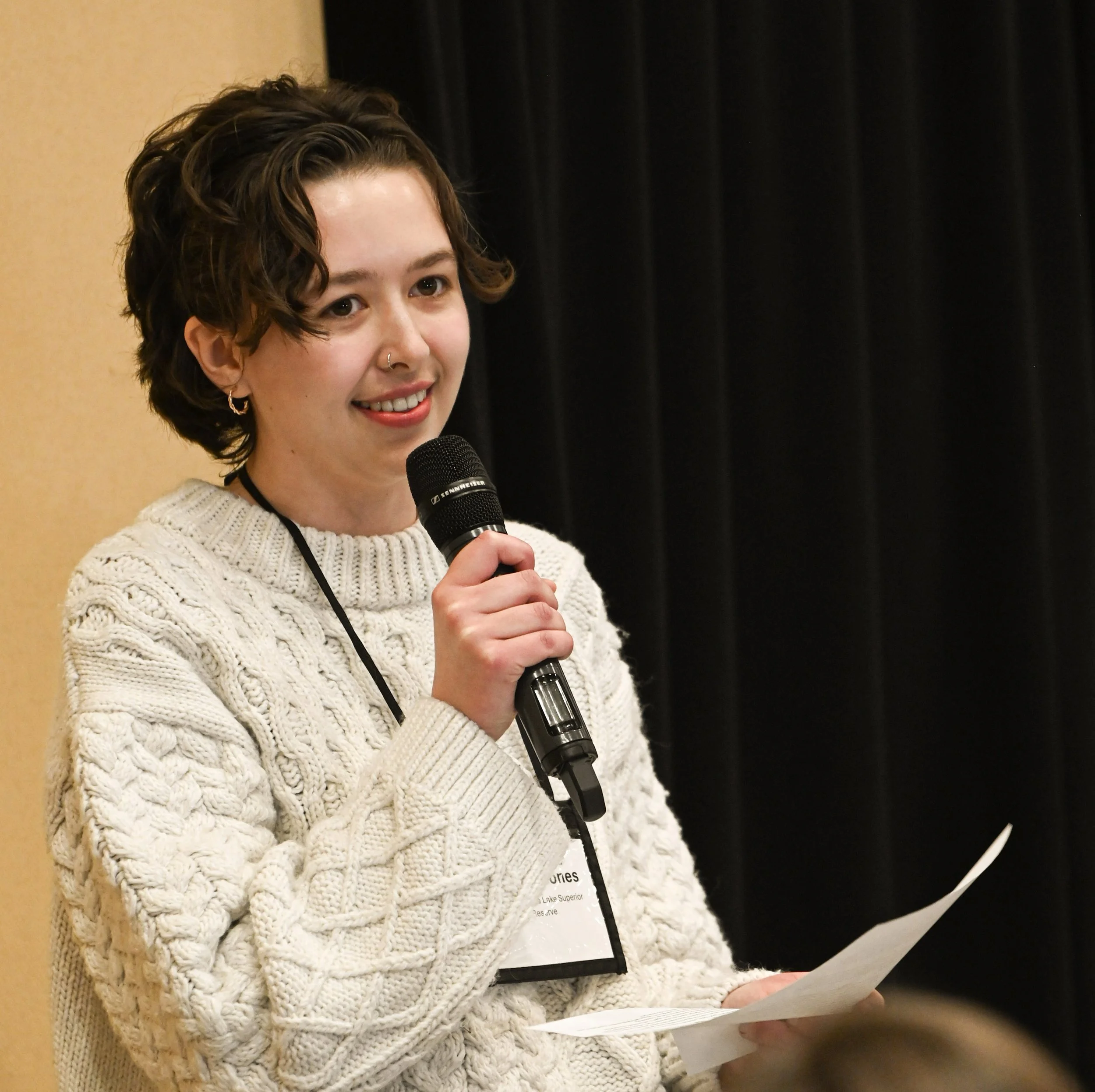
Callie Grones shares her service story, “A Little Help from my Friends”, with attendees of the St Louis River Summit. (credit Michael Anderson)
My name is Callie Grones, and I am an AmeriCorps member working with both the Lake Superior Reserve and Friends of the Lake Superior Reserve non-profit organization. I’ve been working in this position for about a year and a half. The position has existed for four years now thanks to the Friends board, and particularly, founding board member Mike Koutnik who championed the effort.
To say I’ve fallen in love with this work is an understatement, and the opportunities I have been afforded as part of my job are innumerous. There’s nothing inherently glamorous about the AmeriCorps program. Most of the work that AmeriCorps folks do could be considered “gritty”. The program is intentionally designed to find places that need assistance the most and fill them with curious, hardworking people.
In my first week working with the Reserve and Friends back in September of 2024, I began to understand that a place as majestic as the headwaters of the Great Lakes requires a great deal of caretaking, planning, coordination, collaboration, and connection. To illustrate that point, in my first week as an AmeriCorps member, I had orientation on Monday, pulled buckthorn on Clough Island on Tuesday, attended a Coastal Training Program workshop and helped with the Gibiskising-minis Azhe Dibinaweziwin opening celebration at Wisconsin Point on Wednesday, participated in a St. Louis River Habitat Workgroup meeting on Thursday, and helped to co-host a Starry Skies event on Barker’s Island on Friday. (Whew!) From my somewhat limited experience, it seems the way to orient yourself to the work along the St. Louis River estuary is just to jump right in.
In my day-to-day work life, I do communications and outreach for the Friends of the Lake Superior Reserve. I plan volunteer and community events, write newsletters, participate in Reserve field work with stewardship, research, and monitoring staff, or even help with field trips alongside the education team.
However, one of the best parts of my work is that I get to meet with so many people along the estuary with different projects and passions.
I attend monthly meetings with Friends of the Lake Superior Reserve board members, all of whom dedicate time outside of their daily lives to supporting the organization.
Will Mowchan and Lisa DeGuire, both Friends board members, help me plan awesome Wisconsin Point beach cleanups.
I’ve learned how to be a good boating assistant to Addi Knoll, the Reserve’s Water Quality Technician, as we travel the estuary to collect water samples.
I’ve worked with Reserve students David Waite and Daniel Schwartz on plant monitoring and surveying on both Nekuk Island and Wisconsin Point, while Kirsten Rhude, the Reserve’s Stewardship Coordinator, and I spent a very mosquito-ey morning at Wisconsin Point this summer for blueberry monitoring.
I’ve pulled buckthorn and planted tree saplings with the Wisconsin Conservation Corps and Dara Fillmore with the Wisconsin DNR.
I’ve planned poster presentation workshops with Maggie Larson at LSRI.
I helped light the culturally prescribed fire at Wisconsin Point with the wildland fire crews from the Fond du Lac Band of Lake Superior Chippewa and the Superior Fire Department.
I sat in planning meetings with Jim Paine, Ryan Wintlend, Bridgit Maruska, Cam Vollbrecht, and Howie Huber from the City of Superior. I also learned so much about fire in those meetings from Vern Northrup, Fond du Lac Band Elder and retired Wildland Fire Operations specialist with the BIA, and John Schwingel, Wisconsin Fire Manager for The Nature Conservancy.
I flooded my waders as I tried to keep up with the Ravelfest crew at the Wisconsin Department of Natural Resources as we packed up the manoomin exclosures for the season. They looked like they had done this once or twice before.
I’ve looked for tree sapling tags using a metal detector, which is something I never thought I would say, in Walleye Alley, Duck Hunter, and Landslide Bays with students from Michigan Tech.
I’ve gotten birding lessons from Pat Collins and Margie Menzies while assisting with hikes for the Everyone Can Bird events. I hold the field guides, they share their knowledge, and I get as much out of those walks as the attendees do.
I can always count on Jim, Cheryl, Carla, Tammie, and Heather to help staff the Estuarium. Come visit and say “hi” to them if you’re ever in the area.
These are only some of the opportunities I’ve had over the last year and a half to work with many of you in this room right now. I wish I had more time in this story to thank you all properly, but for now I will say thank you to all of you at once. You all have taught me so much and gave me the space to work hard and grow.
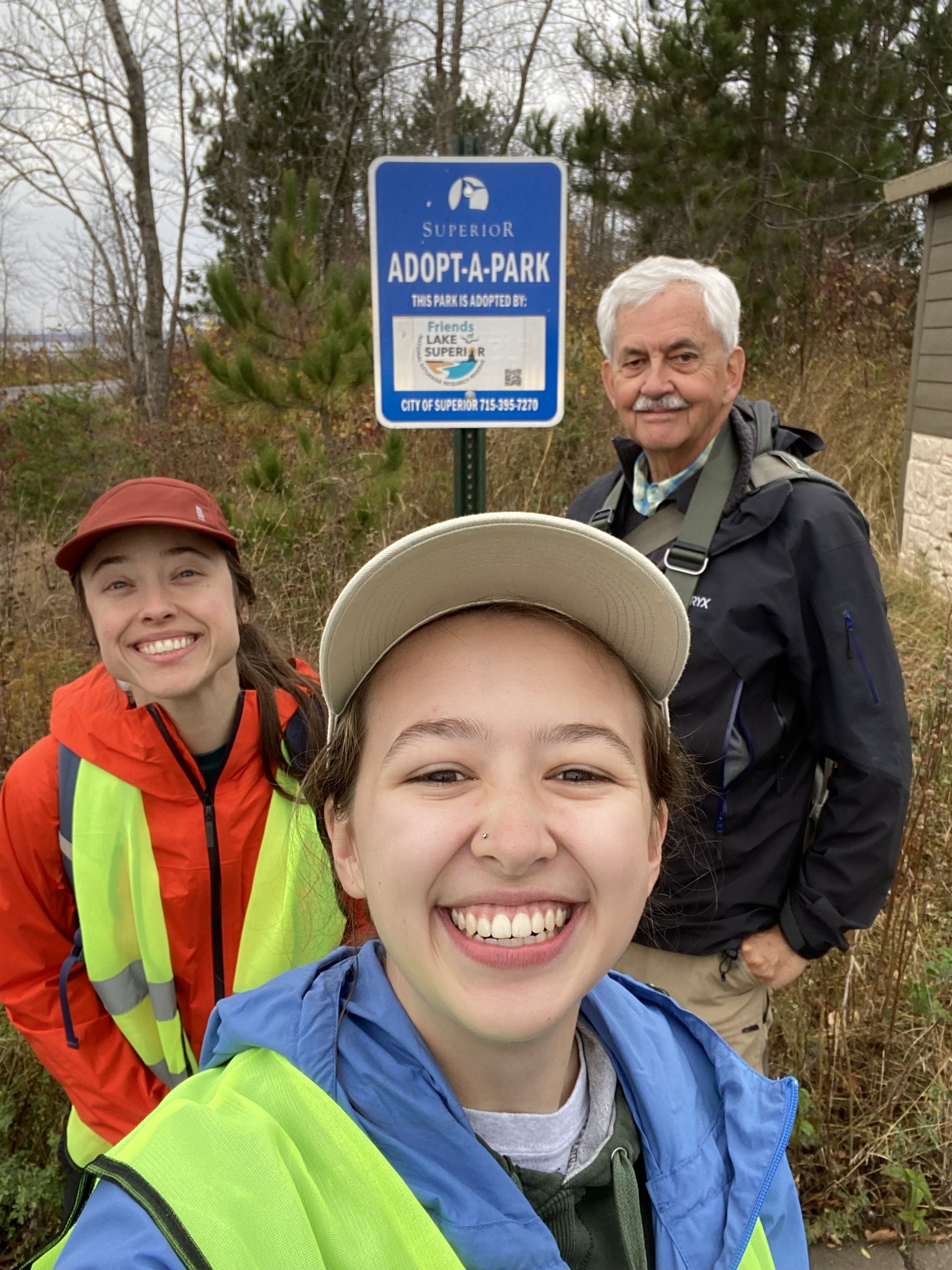
Callie, Lisa DeGuire, and Will Mowchan at the FOLSR fall beach cleanup 2024. (credit: Callie Grones)
Not every part of these service terms have been easy. Probably the hardest part came a few months into 2025 when I heard a rumor. There were rumblings among AmeriCorps programs and federal staff that our work no longer aligned with the federal government’s priorities. In mid-April 2025, there was an initial sweep of cuts through the program, which I managed to miss. Then, on Monday, April 28 at 10:00 am, I got an email in which I read the following.
It has been determined that our awards no longer support governmental agencies’ priorities. You must immediately cease all member and host site activities. This is a final agency action and is not administratively appealable. Turn in all host site equipment and return home.
Nearly $400 million in grant money and an estimated 32,000 AmeriCorps members like me were gone within a day. “Return home”. I didn’t think that was possible, because it wasn’t. This place has become my home. This work was my life, and I have all these connections with people I care about.
Just how nature responds to stress, the reaction began immediately. I did not go home and chose to keep working. There were water samples to collect, birding events to prepare for, and newsletters to write, just to name a few. The Reserve and Friends sprang into action. Within three days, I had a temporary position with UW-Madison Extension. I would later find out that some of the Friends of the Lake Superior Reserve board members put up their own money to support the cost of keeping me on. After a very long and stressful week, to learn that information was incredibly overwhelming.
About two months after the decision was made to cut AmeriCorps funding, I was with Deanna at an interpretive sign unveiling for the Bark Bay Slough boat launch site.The summer evening was so peaceful, and I thought that estuaries must be magical no matter where you are. I received the news while admiring a Kingbird perched on one of the bogs, that AmeriCorps programs was reinstated in 24 states after a breaking judicial decision.
By the beginning of July 2025, I was back in the AmeriCorps program, continuing the work I had been doing for several months. I even got the chance to extend my term for another year, something I had been wanting to do before the program was shut down. As I continued to attend events and work on projects with partners, I was astonished by how many people asked me about how I was doing.
Was I still with the Reserve and Friends group? How long would I be working there? Was the AmeriCorps program reinstated? I felt the care from both people I saw regularly and had only worked with, or even just met a handful of times. It made me feel like I belonged here, like I had found a place in a community of people who work on many different things, but all towards the same goal.
It’s worth the time in this story to reiterate a point that has been evident to me ever since I arrived here. This is a special place. Other places do not feel the same way that this place does. Your work, no matter who you are in this room, makes this place what it is. All of you in this room, and those of us who came before, understand the work it takes to care for this estuary. I see the evidence of that work every morning as the sun shines on the surface of the water while I drive my car along Marina Drive to the little blue building on Barker’s Island. You cannot deny the magic that exists here.
And I understand now that it’s not just because of the estuary itself. The estuary is a place that hosts beings of all shapes and sizes, trees and forbs and birds and manoomin just to name a few, and all of you are included in that. It takes all of us to do this work together. Difficulties have or will affect the work we do at some point. But, I take comfort in knowing there is a community of people here who truly care about each other and the role that we play to make this place what it is. I have been so lucky to make so many friends here, and I hope that you take comfort in knowing that you are surrounded by a special place and truly passionate, hard working, and kind-hearted people.
Article by Callie Grones
Cover photo: Callie Grones poses with the FOLSR sign and trash collected at the 2025 beach cleanup event. (credit: Will Mowchan)